New free TD Snap template: Communication Bill of Rights
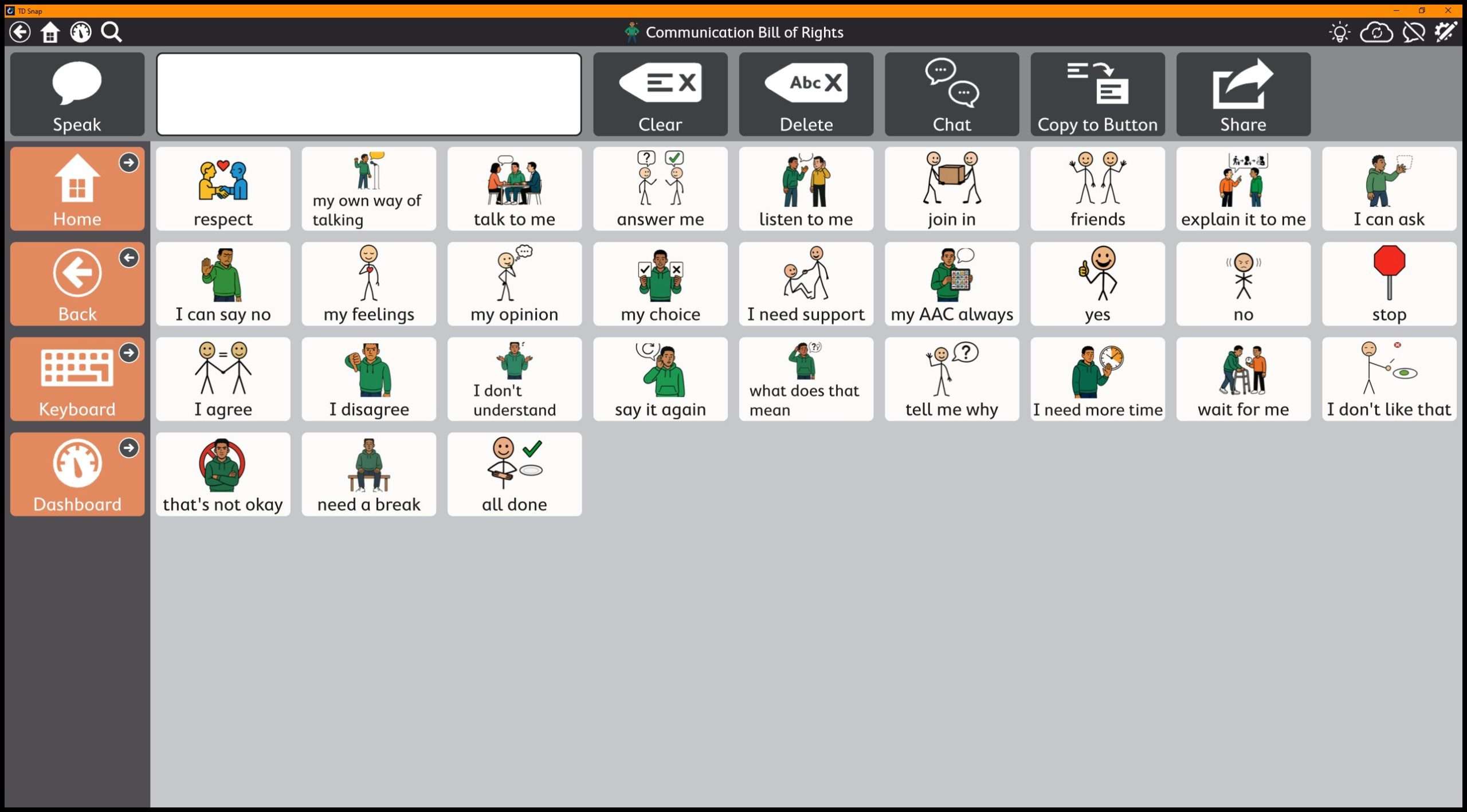
One TD Snap page that turns the Communication Bill of Rights into short sentences a child can say: the right to ask, to say no, to be heard.
The Communication Bill of Rights, written by the National Joint Committee for the Communication Needs of Persons with Severe Disabilities and shared by ASHA, says every person has the right to communicate. The wording is long and formal, so each right here is one short button that speaks one first-person sentence, such as I have the right to be treated with respect or I have the right to an answer, even when the answer is no.
The rest of the template is the words a person uses to stand on those rights: yes, no, stop, I don’t understand, say it again, please wait for me and I need a break. Use it to teach the rights, to post a printable copy in a classroom, or to give a person the words in the moment.
What’s on the pages
- Communication Bill of Rights: respect, my own way of talking, talk to me, answer me, listen to me, join in, friends, explain it to me, I can ask, I can say no, my feelings, my opinion, my choice, I need support, my AAC always, yes, no, stop, I agree, I disagree, I don’t understand, say it again, what does that mean, tell me why, I need more time, wait for me, I don’t like that, that’s not okay, need a break, all done.
It is a TD Snap page set. Each page keeps its own fixed grid, so every button shows whatever page set the device uses, and the same row along the bottom moves between its pages. TD Snap templates are new for us: tell us how the import goes.
It is free, like everything in our library. Get the Communication Bill of Rights template for TD Snap, or browse the whole free library.
Need something we do not have yet? Tell us what to build. Requests from families are where most of these come from.